


How imec turned a climate literacy workshop into a blueprint for sustainability engagement across the semiconductor industry.
The Story
Wouter de Groot had spent 9 years at imec in Business Development, a role that kept him airborne across Europe and beyond. Wouter was good at his job, and the travel was part of it. But on a flight somewhere over the Atlantic, his calculus changed.
Wouter couldn’t ignore the carbon footprint of his own professional life. He realized, “I couldn’t reduce my travel significantly […] but I could raise awareness.” A seed was planted.
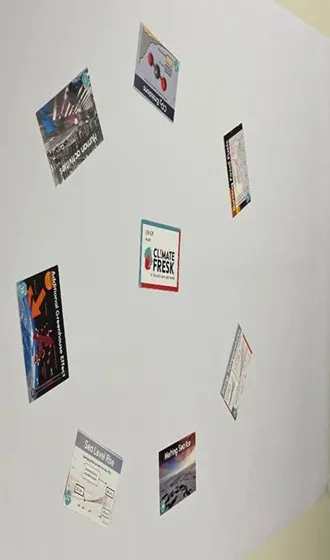
In France, Wouter discovered the “Climate Fresk” (La Fresque du Climat), a collaborative, card-based workshop built on science from the Intergovernmental Panel on Climate Change (IPCC). He got trained as a facilitator and returned to imec’s Leuven headquarters with a quiet mission. The first session, held with a small group of HR colleagues in late 2023, was intended as a test. Yet even for that test, what happened surprised everyone in the room:
"I was blown away by the depth of the discussions. It wasn't just about facts. It was about how people felt, and what they wanted to do next." —Wim Fyen, Director of Sustainability, imec
This is the story of those people, the initial hesitations they faced, and the tipping points that firmly established imec’s Climate Fresk movement.
The People: 6 Unique Entry Points
By the time imec presented at the SEMI Climate Equity and Social Impact (CESI) workgroup in June 2025, more than 400 employees had participated. What made it work wasn’t a mandate or a budget line. It was 6 people who found their way to the Climate Fresk from completely different starting points. Without any coordinated plan, they built something unlike anything imec had ever seen. From the 6:
- Wouter de Groot acted before there was infrastructure in place. Certified with sponsorship from imec, he ran the first session himself and passed it on to anyone willing.
- Ann-Sophie Vanwinsen, a Procurement Specialist, got certified as a Climate Fresk facilitator outside imec, well before the program was ever offered internally. Vanwinsen has facilitated more sessions than anyone else at the company. She confessed, “I’ve shamelessly taken over using my job for sustainability purposes.”
- Matthias Nauwelaers from imec.academy felt very emotional during his first session. A graph showing the climate burden falling on future generations hit him somewhere data alone never had. He too signed up as a facilitator and now weaves the Fresk into employee onboarding and e-learning sessions on sustainability.
- Wouter Machiels, Head of Procurement, came in skeptical. Sustainability, in his experience, had mostly been a compliance checkbox. While Wouter wanted to do more, he felt he lacked the specific tools to act on instincts he already had. The Fresk gave Wouter a framework he hadn’t found elsewhere: “it explained a number of mechanisms I had in the back of my head but couldn’t vocalize.” He left a facilitator himself and has since built a team mapping imec’s entire Scope 3 emissions.
- Lizzie Boakes, one of imec’s Life Cycle Assessment researchers and a ‘SEMI Europe 20 Under 30’ honoree, described what shifted for her: “I’m usually trying to hit numerical targets that don’t seem very real or human. The Fresk takes the scientific aspects out and highlights the social components. It puts people in a position where they have to be expressive with individuals they’re not necessarily close with.” Boakes became a facilitator, too.
- Filip Merckx, CFO, felt anger, then urgency, then a sense of responsibility he couldn’t shake. He introduced the Fresk to his entire management team on an offsite and became co-chair of a newly established sustainability board.
“Easy in hindsight to say everything was planned, but it wasn’t,” said Wim Fyen, imec’s Director of Sustainability, who served as the connective tissue throughout. “We just went with the flow.”
The Hesitation: Bridging Bottom Up and Top Down
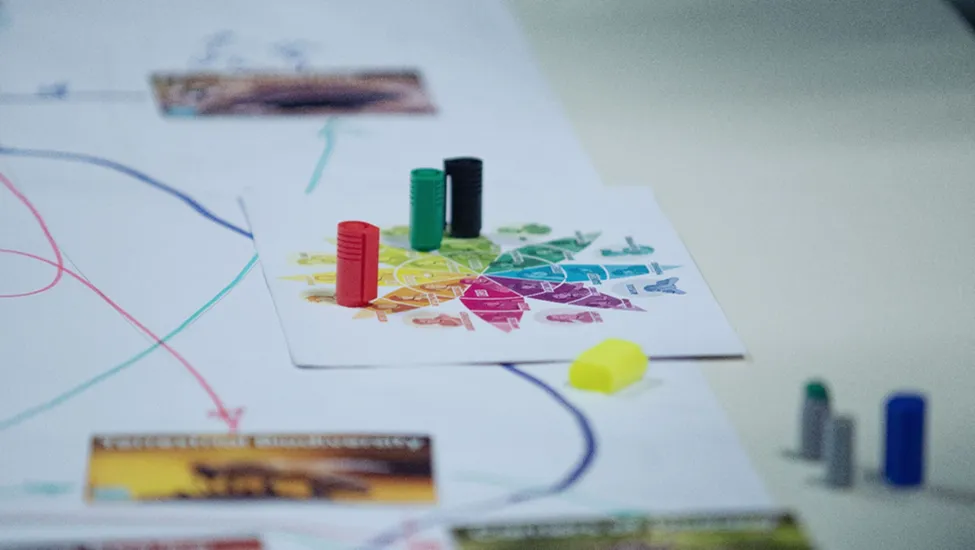
Senior management valued sustainability, but a 4-hour workshop was a significant ask in a calendar already full. The early response was practical rather than resistant: how do we justify the time? It’s a familiar dynamic. Research on bottom-up sustainability initiatives notes that organizations relying primarily on top-down approaches can miss innovative insights that emerge from employees at all organizational levels (Erzurumlu et al., 2025). Imec found a way around it.
Fyen looked for the most efficient way to get it rolled out in imec. He first got the Climate Fresk listed in imec’s learning management system (LMS), a small move that gave it organizational legitimacy without requiring anyone to mandate it. Once the training appeared in the company’s catalog, Fyen leveraged that legitimacy to persuade managers to participate. The budget problem landed differently. Getting the first cohort of facilitators trained required money nobody had earmarked. Machiels solved it by encouraging like-minded suppliers to make sustainable initiative contributions. As a result, the first group got financed without a single line item in the sustainability budget.
Both moves mattered. The same research argues that meaningful change requires not only employee initiative but also adequate executive support and corporate financial resources to sustain it (Erzurumlu et al., 2025). The LMS listing supplied the institutional legitimacy. The supplier co-investment supplied the resources. Together they pulled the Fresk from ‘one person’s project’ into something the organization could carry.
"You train 1 person as facilitator for less than 1,000 euros, and then they can run unlimited sessions inside the company at just a few euros per participant for license fees. Compared to external coaches, it's 30 times more cost-efficient." —Wim Fyen
That economics produced a virtuous cycle. Low cost per session lowered the bar for departments to host one. Each session generated interest, which recruited more facilitators, which enabled more sessions. Similar grassroots-to-organizational arcs have played out elsewhere in the industry, where employee-led sustainability initiatives at ASML gained traction once they were paired with executive sponsorship (https://www.semi.org/en/blogs/one-tree-per-employee-how-a-grassroots-initiative-in-asml-san-diego-is-assembling-restorative-future-with-real-results). At imec, the initial constraint of having no dedicated training budget became a feature: it forced a model lean enough to scale.
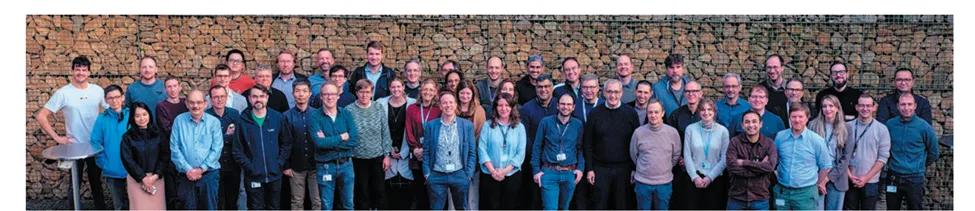
Participants in imec Climate Fresk Workshop for Managers
The Tipping Points: When Organic Became Structural
What came next for imec was a mass Fresk; 50 managers, 14 internal facilitators, 1 afternoon. During the workshop, each participant wrote a personal commitment on seed paper, and those seeds were planted on the imec campus. "The flowers represented their ideas blooming," Fyen said. For a scientific culture, having something tangible to point to mattered.
Not long after this, in late 2024, the team of Climate Fresk facilitators received the Sustainable.minds award at imec's annual corporate personnel event, recognized for sparking vital conversations about sustainability and inspiring action for the planet. For a community of facilitators that had grown almost entirely through word of mouth, this formal recognition validated what they had already built and gave their work significant internal visibility.
In 2025, entire departments were booking on-demand sessions. About 25% of all participants expressed interest in becoming facilitators themselves. But why? According to a group of French environmental psychologists, emotional engagement is one of the primary pathways through which collaborative climate workshops produce real attitudinal change and pro-environmental intent (Hognon et al., 2026). And the good feeling that follows, which some researchers call the "warm glow," creates a self-reinforcing cycle toward deeper engagement (Schneider et al., 2021).
"Convinced that without the information of the Climate Fresk, and without my team having lived through it themselves, we would not be where we are today in value chain mapping and the visibility we have on our Scope 3." —Wouter Machiels, Head of Procurement, imec
Scaling beyond the borders to impact the entire value chain
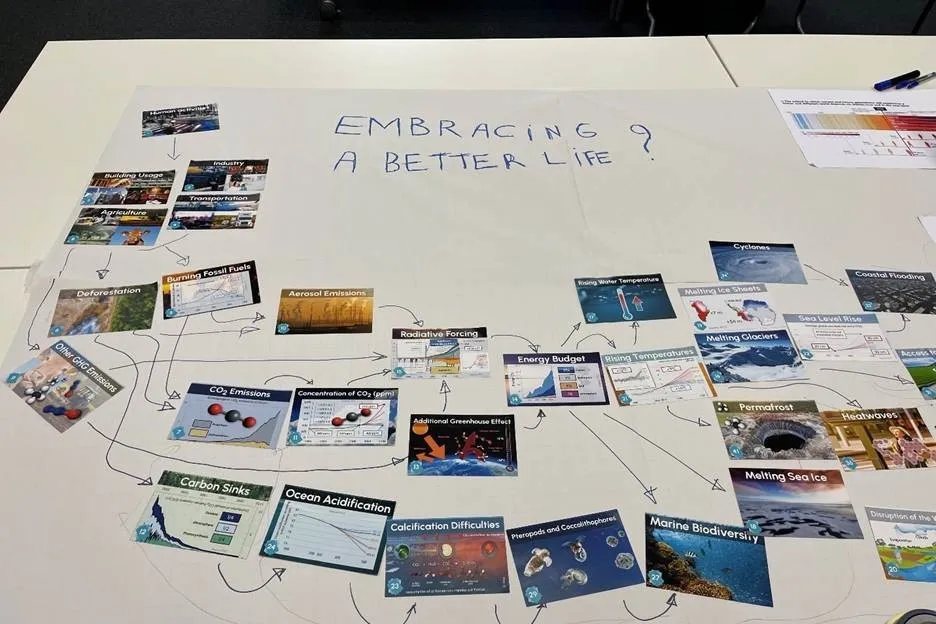
Fueled by the recognition given by the Sustainable.minds awards, the team began offering Climate Fresk sessions to imec’s partners at the biannual Partner Technical Week (PTW) international conference and the workshop started crossing imec’s borders for the first time. This brought it to the attention of SEMI members. At a CESI workgroup meeting in 2025, participants from Tokyo Electron, Axcelis, Advantest, Applied Materials and Veeco among others listened to imec’s story and asked how to bring it to all of SEMI’s membership. Wojtek Osowiecki at Lam Research, founder of the Lam Employee Sustainability Community, was one of the first outside participants at an imec Fresk. He put it simply: “It’s not just about awareness. It’s about empowerment. The Fresk gives people a voice and a framework for action.”
By the Fall of 2025, the first Fresk had been held at SEMICON West, and conversations with SEMI member companies were underway. What had been an internal experiment was now something other organizations wanted to learn from.
A Movement of Belonging with Concrete Outcomes
Founded in 1984 as the 'chip lab of the world,' imec has always been committed to sustainable development for generations to come by teaming up with the entire microchip value chain
Its biggest leverage takes place through its Sustainable Semiconductor Technologies and Systems (SSTS) program in which imec works closely with partners from across the industry to assess and reduce the environmental impact of chip manufacturing, including foundries, integrated device manufacturers, equipment suppliers, and materials companies.
This program runs along two connected tracks: assessment, whereby the environmental footprint of current and next-generation integrated circuit technologies are quantified and improvement where the insights of the first track are used to develop and validate practical solutions (e.g. to reduce process-related emissions, including work on low-impact gases, per- and polyfluoroalkyl substances (PFAS) alternatives, and novel manufacturing processes).
The success with the Climate Fresk workshop has also begun to feed the broader SSTS program. Tools like the Environmental Score, originally developed for chip manufacturing assessment, are now being integrated into other design processes across the organization. The Fresk is now one of the vehicles imec uses to train and inspire the people who will carry that integration into their day-to-day work; the workshop builds the awareness, and SSTS gives that awareness somewhere to go.
And there are several noteworthy concrete outcomes across imec:
- An ESG board now exists at the executive level, where leaders set corporate sustainability goals and assign the resources to pursue them. That board did not exist prior to the Climate Fresk. It was an indirect consequence of the awareness created within the finance team after Merckx introduced the workshop to his management. Decisions about sustainability that had previously lived in scattered conversations now have an institutional home.
- Onboarding has changed too. Nauwelaers, from imec.academy, has woven the Fresk into how new employees encounter imec. Sustainability is no longer a topic that gets introduced after someone is hired and oriented; it is part of the introduction itself. New colleagues meet the company’s climate posture in their first weeks rather than their first year.
- And in procurement, Machiels has built a sustainable procurement team of 3 FTEs and a PhD student, supported by a supplier co-investment model. The team operates against a multi-year sustainability plan and has produced the most detailed picture of imec’s Scope 3 emissions the company has ever had. The procurement function, often the last to be touched by sustainability work, became one of the first at imec to be reshaped by it.
Fyen is honest about the distance still to travel. At 600+ participants in a company of 6,500 (roughly half non-payroll), imec has reached roughly 20% of its own workforce. That means in principle there are still thousands to reach. But Climate Fresk facilitators are now embedded in every corner of the organization, people who came to a workshop for their own reasons and left with a mission they didn’t expect. And more importantly, social science learns us that once a critical ‘tipping point’ is reached, adoption can grow very rapidly (Centola et. al., 2018).
Machiels observed that the Fresk quietly became one of the few things that gave colleagues from completely different parts of imec a genuine sense of belonging to something. Climate Fresk has allowed them to understand the science, hear the human stories, and start connecting the dots. In a world of hybrid schedules and activity-based offices, for the people inside imec who went through the workshop together, that shared experience has become something else too.
From a quiet decision on a plane, imec built a movement that now extends well beyond its own walls. Those seeds are available to any company where even one person is willing to start.
This case study was written by Nat Mengist and Marley Hauser. It was produced by SEMI in partnership with imec as part of the SEMI Climate Equity and Social Impact (CESI) workgroup, led by staff member Justin Harris ([email protected]). For more information, visit semi.org/sustainability or connect through the SEMI CESI workgroup.
SEMI SUSTAINABILITY CASE STUDY ADDENDUM
A Blueprint for Building Your Own Climate Fresk Movement
What imec built was not a program. It was a set of conditions. The following 5 steps are drawn from their experience; a starting backbone that your organization can adapt, with imec and the CESI workgroup as a resource to build it out further.
1. Find the person who won't wait for permission.
Every successful rollout in imec's story starts with someone who acts independently of pre-existing infrastructure. That person is probably already in your organization. Find them, fund their facilitator training, and let them shine. Research conducted on Wojtek Osowiecki’s Lam Employee Sustainability Community shows that this kind of bottom-up entrepreneurial ownership produces the most durable organizational commitment (Erzurumlu et al., 2025).
2. Give it a home in the official infrastructure.
Getting the Climate Fresk listed in imec's learning management system moved it from "one person's project" to "an official training." That's a small change with a large impact. Connect your internal champion with key departments like HR or Learning & Development. Sustainability initiatives that live only inside the sustainability team have a ceiling. The ones that spread into other departments like HR, Procurement, and Operations don't.
3. Protect the emotional architecture of the workshop.
The instinct is to shorten the workshop to fit busy schedules. Imec did the opposite, extending to 4 hours and adding a plenary on personal and corporate carbon footprints. The "Embrace Your Emotions" phase isn't optional. It's the mechanism through which information becomes motivation. This is the worrying and urgency feeling Filip Merckx described. Some research found this “negative affect” to be the single strongest predictor of willingness to engage in climate action (Brosch, 2021). Cut that phase and you save an hour, but you’ll also miss the point.
4. Build for the skeptical majority, not the converted few.
The Climate Fresk also works well with technical audiences because it's built on IPCC science and run by a neutral peer rather than an external consultant. When a colleague walks you through the system map, the psychological distance that usually makes climate change feel abstract suddenly collapses. By developing teams of internal facilitators across departments, levels, and geographies, you will begin to witness the “gradual accumulation” of passionate sustainability culture (Russi et al., 2024).
5. Extend your horizon beyond 12 months.
The procurement team Wouter Machiels built — 4 FTEs, a PhD student, a supplier co-investment model — didn't exist when the Fresk was first introduced. "Facts are the foundation, but stories are the vehicle," Wouter claimed. "You can broadcast facts all you want. If you're not having an impact on the people listening to you, then you're casting salt." Don't expect ROI within one budget cycle. The outcomes that matter most take years to show up. But they do show up.
 |  |
Research Foundation
The behavioral science behind the Climate Fresk is not incidental to its design: it is the design. The following sources informed both the blueprint above and the case study narrative.
Brosch, T. (2021). Affect and emotions as drivers of climate change perception and action: A review. Current Opinion in Behavioral Sciences, Human Response to Climate Change: From Neurons to Collective Action, 42, 15–21. https://doi.org/10.1016/j.cobeha.2021.02.001
Centola, D., Becker, J., Brackbill, D., Baronchelli, A., (2018). Experimental evidence for tipping points in social convention. Science 360,1116-1119.
https://www.science.org/doi/abs/10.1126/science.aas8827
Erzurumlu, S. S., Osowiecki, W. T., & Seidel, V. P. (2025). How an Environmental Sustainability Community Fostered Employee-Driven Innovation at Lam Research. Research-Technology Management, 68(4), 21–29. https://doi.org/10.1080/08956308.2025.2497220
Hognon, L., Caille, P., Bernard, P., Chevance, G., & Teran-Escobar, C. (2025). Assessing the impact of The Climate Fresk workshop on climate-related attitudes and behavioral intentions in the workplace: Study protocol for a randomized controlled trial (2qvgd_v1). PsyArXiv. https://doi.org/10.31234/osf.io/2qvgd_v1
Hognon, L., Teran-Escobar, C., Bernard, P., Chevance, G., & Caille, P. (2026). A call for robust evaluations of the impacts of serious games for climate change mitigation: The Climate Fresk as a global case study. Journal of Environmental Psychology, 110, 102942. https://doi.org/10.1016/j.jenvp.2026.102942
Mosquera, J., & Jylhä, K. M. (2022). How to Feel About Climate Change? An Analysis of the Normativity of Climate Emotions. International Journal of Philosophical Studies, 30(3), 357–380. https://doi.org/10.1080/09672559.2022.2125150
Russi, L., Renouard, C., & Wallenhorst, N. (2024). Beyond Rupture, Interstice and Reform: Searching for Nuance in the Portrayal of Engagement for Social and Ecological Transition. Journal of Business Ethics, 193(3), 471–479. https://doi.org/10.1007/s10551-023-05568-w
Schneider, C. R., Zaval, L., & Markowitz, E. M. (2021). Positive emotions and climate change. Current Opinion in Behavioral Sciences, Human Response to Climate Change: From Neurons to Collective Action, 42, 114–120. https://doi.org/10.1016/j.cobeha.2021.04.009


