


The semiconductor industry is important for a myriad of reasons. We are all familiar with how these tiny chips full of electricity and nanotechnology fuel innovation and global connectivity, impact our economy, and play a vital role in national security. We also acknowledge that, just as it took decades to achieve such technological success, it also required many innovators from different backgrounds who contributed an array of perspectives and specialized knowledge. The advancement of this industry is essential to our economic growth and national security, and its historical development is significant. In honor of Black History Month, we appreciate and celebrate the impact of Black innovators in STEM who helped lay the foundation for semiconductor technologies.
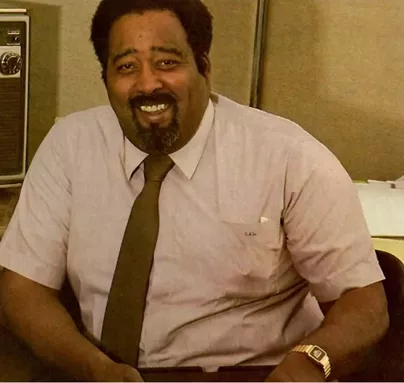 Engineer and video game developer Jerry Lawson |
Back in 1958, Fairchild Semiconductor in San Jose and Texas Instruments in Dallas both developed the integrated circuit (IC), setting the stage for future tech innovations. Fast forward to the early '70s when Gerald “Jerry” Lawson, an engineer at Fairchild, took that foundation and changed the gaming world forever. Lawson led the team that created the Fairchild Channel F, the first console to use ROM cartridges—making it possible to swap out games instead of being stuck with the ones built into the system. Before that, he even built a coin-operated game called Destruction Derby using Fairchild’s F8 microprocessor. Thanks to Lawson’s work, we went from basic arcade games to the expansive gaming experiences we have today. So, the next time you fire up your PlayStation or Xbox, give a nod to Jerry Lawson, the father of the game cartridge and a true pioneer in the industry.
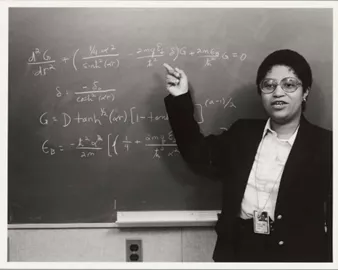 | 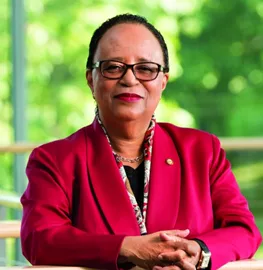 |
| Dr. Shirley Ann Jackson as an employee at Bell Labs. (wowstem.org & aip.org) | |
Bell Labs made history in 1947 with the invention of the transistor, a game-changer for electronics. Years later, Dr. Shirley Ann Jackson, the first African American woman to earn a Ph.D. from MIT, carried that legacy forward with her groundbreaking research at Bell Labs. Her work on electronic switching and signal processing helped make modern telecommunications faster and more reliable. Thanks to her theoretical contributions and advancements in strained-layer semiconductors, the way data travels over long distances was completely transformed. So, the next time you’re streaming a video or making a call, you’ve got pioneers like Dr. Jackson to thank for the tech that keeps us all connected.
Many more historical figures from the Black community have made significant contributions to STEM. Here’s just a small sample of those pioneers and their achievements:
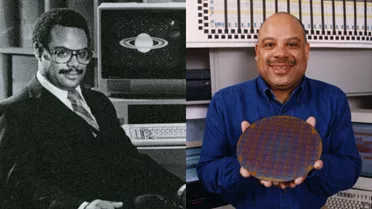
Dr. Mark Dean via @IBM on Twitter
Dr. Mark E. Dean co-developed the first gigahertz microprocessor, capable of performing a billion calculations per second, and holds three of the original nine patents for the IBM PC.
- Dr. Frank S. Green Jr. made key contributions including advancements in thin-film transistors, integrated circuits, and semiconductor materials, shaping modern microelectronics and solid-state devices while at Bell Labs.
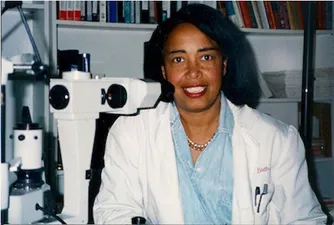
Dr. Patricia Bath (prnewswire.com)
Patricia Bath developed laser technology for cataract treatment powered by diode (semiconductor) lasers.
- Dr. James E. West was a co-inventor of the foil-type electret technology that influenced MEMS microphones, which use semiconductor microfabrication techniques to create highly sensitive, miniaturized audio sensors.
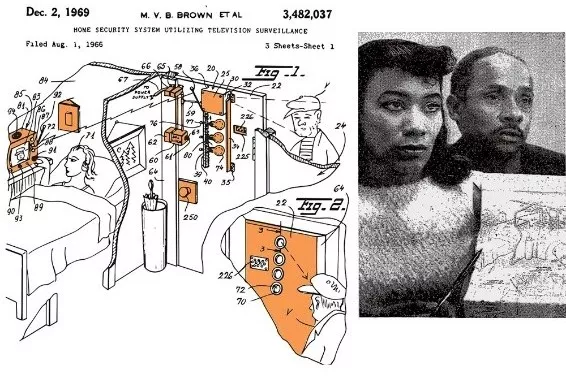
Left, a portion of the patent plan designed by
Marie Van Brittan Brown and her
husband Albert, right. (Marie Van Brittan Brown and
Albert L. Brown, courtesy U.S. Patent and
Trademark Office; New York Times / Redux)Marie Van Brittan Brown invented the closed-circuit television (CCTV) security system, a precursor to modern surveillance technology, demonstrating how semiconductors transformed security systems and paved the way for the advanced digital surveillance systems we use today.
- Valerie L. Thomas was a physicist, inventor and NASA analyst who patented illusion transmitter technology that projected the appearance of a 3D image. This virtual reality-like technology is still used by NASA today.
For many young people, a lack of role models in STEM can discourage them from considering these fields. When students don’t see individuals who share their backgrounds or experiences represented in these industries, STEM careers can feel out of reach or unwelcoming. Seeing people who have similar stories helps break down those barriers and shows students that these paths are open to them.
There’s a deep sense of pride and fulfillment in supporting workforce development and opening doors for the next generation. By bringing attention to the often-overlooked contributions of Black inventors, scientists, and engineers—especially in the semiconductor industry—we hope to inspire a wider range of young people to explore these opportunities. Sharing these stories not only honors those who have shaped the industry but also encourages students to imagine themselves as future leaders in the field.
As the semiconductor industry continues to evolve, it’s essential to build a strong talent pipeline that is welcoming to all. Even from non-technical roles, we play a vital part in shaping that future by raising awareness, sparking curiosity, and helping young people discover the vast possibilities within this exciting industry.
Jeana Harper-Kirkland is the SCAN Michigan Program Navigator at the SEMI Foundation, focusing on K-16 educator resource management, Educational Research and Dissemination, and supporting Workforce Development training programs.
Richard Walker is the Senior Program Manager of Industry Awareness at the SEMI Foundation
References
Biography.com Editors, “Mark Dean” https://www.biography.com/inventors/mark-dean
Britannica “integrated circuit” https://www.britannica.com/technology/integrated-circuit
Britannica “Shirley Ann Jackson American scientist and educator”
https://www.britannica.com/biography/Shirley-Ann-JacksonCherry, Ronnia “7 Black Innovators Who Shaped the Tech Industry“ https://www.newegg.com/insider/7-black-innovators-who-shaped-the-tech-industry/
- Harvard (The Center for Hellenic Studies) “Africa: Greek and Roman Perspectives from Homer to Apuleius” https://chs.harvard.edu/chapter/introduction-7/#:~:text=This%20book%20considers%20the%20contact%20between%20Greco-Roman%20civilization,understand%20Africa%20appeal%20to%20the%20realm%20of%20myth.
Hilgers, Laura (Smithsonian Magazine) “Marie Van Brittan Brown”
https://www.smithsonianmag.com/innovation/history-home-security-alarm-180977002/ March 2021How Stuff Works, “Did the ancient Greeks get their ideas from the Africans?” https://history.howstuffworks.com/history-vs-myth/greek-philosophers-african-tribes.htm
Johns Hopkins Whiting School of Engineering “Dr. James E. West”
https://engineering.jhu.edu/faculty/james-west/Nokia Blog “The transistor: 75 years since the famed Nokia Bell Labs invention changed the world” https://www.nokia.com/blog/the-transistor-75-years-since-the-famed-nokia-bell-labs-invention-changed-the-world/
Purdue University College of Engineering, “Frank S. Greene Jr” https://engineering.purdue.edu/Engr/People/Awards/Institutional/DEA/DEA_2002/greene
Rocchio, Laura E.P. “Valerie L. Thomas”
https://mynasadata.larc.nasa.gov/stem-career-connections/meet-dr-valerie-l-thomas-landsat-image-processing-specialistUCLA Health, "Patricia Bath”
https://www.uclahealth.org/news/release/in-memoriam-dr-patricia-bath-76-physician-and-inventor-who-helped-restore-or-improve-vision-for-millionsYarlagadda, Tara "Jerry Lawson Forever Changed the Video Game Industry" 1 January 1970. HowStuffWorks.com. https://science.howstuffworks.com/innovation/big-thinkers/jerry-lawson.htm


