downloadGroupGroupnoun_press release_995423_000000 copyGroupnoun_Feed_96767_000000Group 19noun_pictures_1817522_000000Member company iconResource item iconStore item iconGroup 19Group 19noun_Photo_2085192_000000 Copynoun_presentation_2096081_000000Group 19Group Copy 7noun_webinar_692730_000000Path
Skip to main content
Default Banner Image

John Cooney

The new Administration in the United States has been aggressively focusing on trade measures to establish more balanced relationships with its trading partners, according to the White House.Over the last several weeks, President Trump declared a U.S. economic emergency and announced a universal 10% tariff on all countries, which went into effect on April 5, 2025. There are also levies that Trump has called “reciprocal,” including a 34% tariff on Chinese goods and a 20% tariff on European Union imports, that started on April 9.Previously announced 25% tariffs on foreign-made autos and certain auto parts are also now in effect.Presently, finished semiconductors are exempt from these tariffs, however, a Federal Register notice provided the following update:On April 1, the Secretary of Commerce initiated an investigation under section 232 of the Trade Expansion Act (19 U.S.C. 1862) to determine the effects on national security of imports of semiconductors, semiconductor manufacturing equipment (SME), and their derivative products. This includes, among other things, semiconductor substrates and bare wafers, legacy chips, leading-edge chips, microelectronics, and SME components. Derivative products include downstream products that contain semiconductors, such as those that make up the electronics supply chain. The SEMI Advocacy team is working side by side with member companies in the U.S. to prepare industry’s response for the public comment period tied to the 232 investigation. Comments are due May 7. (Update: SEMI comments submitted.)SEMI has been tirelessly working to educate new policymakers and regulators about the negative impacts the proposed tariffs have on the semiconductor industry. Ajit Manocha, President and CEO of SEMI, and Joe Stockunas, President of SEMI Americas, have been to Washington, D.C. for a series of meetings with administration officials and on Capitol Hill. Clarity on the recent tariff announcements — and guidance on what could come next — has been at the top of the agenda. Additionally, many member company executives recently attended the SEMI Washington Fly-In to advocate for policies that support the global supply chain on Capitol Hill, and the topic of tariffs was of the highest priority for congressional staff.Considering the complexities of the semiconductor industry supply chain, U.S. companies must rely on highly specialized materials, equipment, and components sourced from multiple countries. Strategically deployed and comprehensively assessed trade actions ensure that U.S. businesses maintain market access to critical supplies and remain globally competitive.Additionally, SEMI has highlighted that through fair and reciprocal trade practices, the U.S. can avoid unintended cost increases, supply chain disruptions, and ultimately any risks to American competitiveness in the global marketplace. Coordinating trade policies with allies prevents retaliatory tariffs for industries critical for national security, such as the semiconductor industry, and keeps costs competitive for consumers and industries, all while fostering a more resilient domestic manufacturing ecosystem. Semiconductor companies make substantial investments in building new facilities, and policy stability and predictability are key factors in site selections. With governments around the world putting incentives in place to bolster their semiconductor ecosystems, and to attract industry investments and good-paying jobs, public-private synchronization on trade policies is crucial to help the U.S. meet its technology innovation goals.Visit SEMI Global Advocacy to learn more about public policy efforts and developments as well as how your company or organization can get involved.John Cooney is VP, Global Advocacy Public Policy at SEMI.
Read More
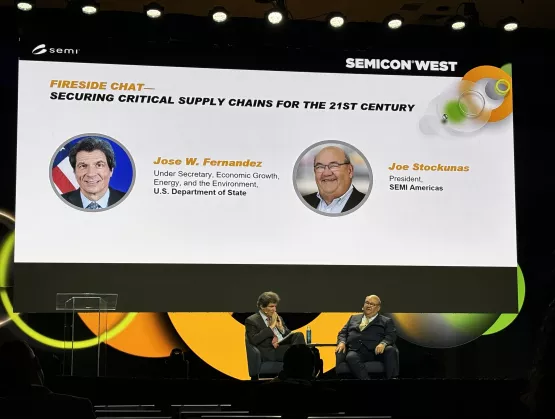
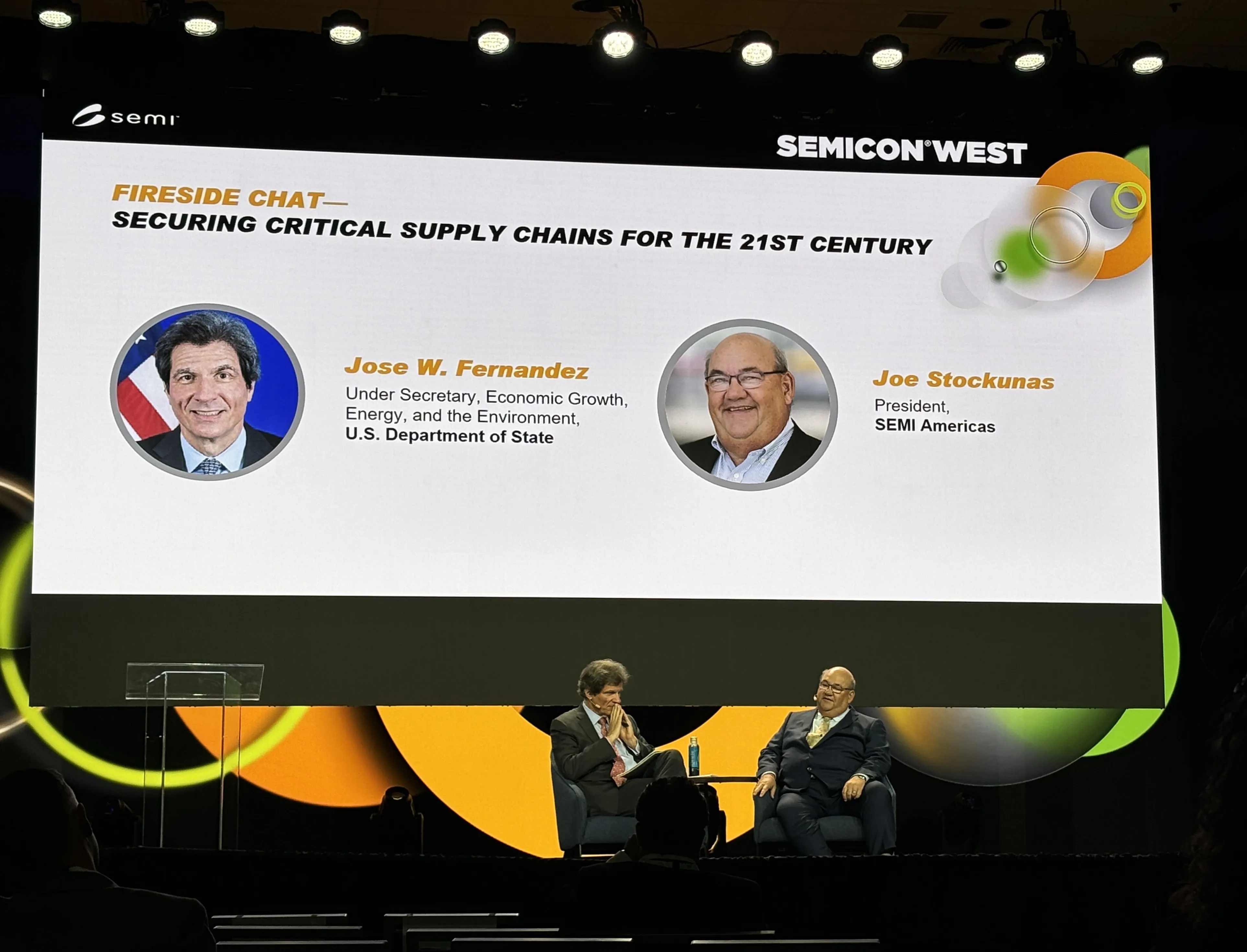
Jose Fernandez, U.S. Under Secretary of State for Economic Growth, Energy, and the Environment, sat down with Joe Stockunas, President of SEMI Americas, for a fireside chat on the CEO Summit keynote stage at SEMICON West 2024. In the Securing Critical Supply Chains for the 21st Century discussion, Fernandez emphasized the need to form partnerships to address vulnerabilities as the key to creating stable supply chains. It’s important to band together, he said, to protect our standards, values, and democracy. Diversifying the Global Mineral Supply ChainBecause chip fabricators depend on minerals like germanium, gallium, arsenic, indium, and rare earth elements, he highlighted how imperative it is for the industry to access them sustainably. To accomplish this, he stressed the importance of protection against supply chain bottlenecks in the mineral market. “According to a number of experts, we’re going to need 42x the amount of lithium by 2050, 25x the amount of manganese, and 25x the amount of cobalt,” he said. “Those minerals are basically controlled by one country, and that's a vulnerability.”To address these concerns, he shared that the State Department is working to strengthen the upstream and downstream portions of the semiconductor value chain, with the goal of supporting economic security across the globe. Foreign export controls, he said, have led to supply chain disruptions of key minerals, and bans on rare earth elements, processing equipment, and other technologies. As evidence of the State Department’s efforts to diversify, he highlighted the Minerals Security Partnership (MSP) and its work to seek mineral alternatives. Led by the U.S., it currently includes 13 other countries plus the European Union. Partnership and Investment Opportunities To further secure the industry's supply chain, Fernandez discussed the State Department’s efforts to partner with mining countries with untapped semiconductor resources. These countries, he said, also want alternate options for securing critical minerals. Fernandez highlighted Latin America as a key nearshoring focus area, pointing to the Americas Partnership for Economic Prosperity (APEP) as a solution for addressing obstacles to investment in the region. Obstacles, he said, include education levels, insecurity, and rule of law.To overcome such hurdles, he stressed the importance of fostering economic conditions that will attract investments, emphasizing the importance of workforce development initiatives and private sector involvement. “We don’t have enough trained workers in the U.S., and we certainly don’t have enough trained workers abroad,” he said. Fernandez shared that workforce development programs are being established through the U.S. Department of State International Technology Security and Innovation (ITSI) Fund, as well as private sector efforts and university partnerships. Currently, seven countries have been selected for ITSI funding, he said. “We’ve partnered with a number of universities to address the workforce gaps we see in our ITSI partners,” he said. “We’ve created workforce seminars, and we’re going to spend more time training the labor force.” These efforts supplement the work of the SEMI Foundation to develop a holistic workforce development program for the global semiconductor industry.Preventing Chips From Entering RussiaWith U.S. chips crossing into Russia through third parties, Stockunas asked Fernandez how the semiconductor industry could help address this. Despite existing sanctions against Russia, Fernandez shared that Russia still managed to import $1.7 billion worth of microchips from both the U.S. and Europe in 2023. To help slow this down, he highlighted additional due diligence for companies whose products often make their way into the country. The federal government, he said, speaks with these companies about complying beyond what the law requires.Fernandez shared that private sector cooperation with more stringent standards has been positive, noting that some companies have cut hundreds of distributors to further aid in prevention. In addition, he mentioned that sanctions have made a promising impact overall.“[Russia] has had to use outdated equipment, they’re engaging in counterfeiting, and they’re getting help from other countries,” he said. ​​Official SEMICON West Podcast In a podcast with Francoise von Trapp of 3D InCites recorded at SEMICON West, Fernandez discussed critical mineral partnerships, benefits and setbacks of regional supply chains, and chip sanctions against Russia. To learn more, check out the podcast interview with 3D InCites. SEMI Global AdvocacyDiscover how SEMI Global Advocacy Public Policy supports the microelectronics industry across trade, taxes, talent, and R D.John Cooney is Vice President of Global Advocacy and Public Policy at SEMI.

Read More
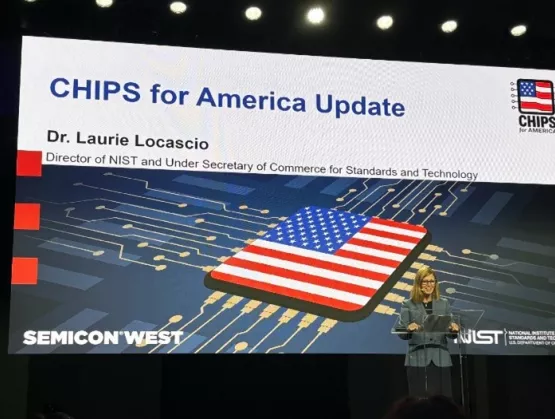
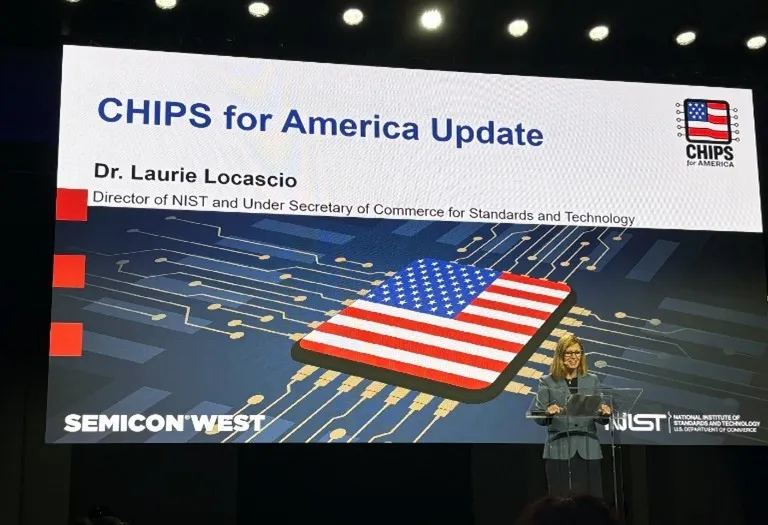
SEMI was honored to welcome U.S. Under Secretary of Commerce for Standards and Technology, Dr. Laurie E. Locascio, to the CEO Summit keynote stage at SEMICON West 2024 on Tuesday, July 9. Locascio, who also serves as the Director of the National Institute of Standards and Technology (NIST), delivered her morning CHIPS Act Update keynote address to a packed room of over 1,000 attendees at the Moscone Center in San Francisco.During her address, Locascio emphasized how far the U.S. chip industry has progressed since 2021. “Prior to 2022 and the passage of the CHIPS and Science Act, the U.S. produced 0% of the world's leading edge chips,” she said. “But now, after these proposed investments, we've changed the global landscape.”Industry Shifts from the CHIPS and Science ActDue to long delays and price increases resulting from supply chain vulnerabilities, Locascio shared that Congress began developing the CHIPS and Science Act with two key goals in mind. The first, she said, was to protect economic security, and the second, was to lower costs for American taxpayers. As part of the CHIPS and Science Act, CHIPS for America was established to advance semiconductor manufacturing in the U.S. CHIPS for America encompasses two offices: The CHIPS Research and Development Office, as well as the CHIPS Program Office - both of which are responsible for implementing CHIPS and Science Act law.CHIPS for America, said Locascio, couldn’t be another procurement program. Instead, it needed to be a purpose-driven approach to build domestic manufacturing capacity. Locascio highlighted that CHIPS for America galvanized several experts from the federal government, R D, and other core areas to work together to revitalize the U.S. semiconductor industry and increase capacity. To achieve this, Locascio pointed to CHIPS for America’s $30 billion in proposed direct funding and $25 billion in proposed direct loans.Locascio also noted diversity of technology as being essential for the American chip industry, citing how Intel, Micron, TSMC, and Samsung have recently expanded in the U.S., with SK Hynix planning to build a fab and R D facility in Indiana. No other economy in the world, she said, has more than two of these companies producing leading edge chips on its shores.“The total public and private investment from our four, leading-edge companies will equal roughly $300 billion between now and the end of the decade, far and away the most investment in new production in the history of the U.S. semiconductor industry,” said Locascio. Industry Investments on the HorizonTo further aid these efforts, Locascio mentioned CHIPS for America’s notice of intent to invest $1.6 billion in an open competition to accelerate advanced packaging domestically and encourage innovation. Funding will be directed toward five key R D areas, including equipment tools, power delivery, connector technology, chiplets, and Electronic Design Automation (EDA), she said. Additionally, Locascio shared that CHIPS for America recently announced its first preliminary memorandum of terms (PMT) to support the upstream supply chain, and shared plans to announce several more PMTs in the future. Lastly, Locascio revealed that CHIPS for America plans to release a model and process for bringing new facilities to life, in partnership with the National Semiconductor Technology Center (NSTC). NSTC members, she said, will gain access to partnership funds and state-of-the-art facilities to support the U.S. semiconductor industry. “Across all these efforts, from manufacturing incentives to research funding, to workforce development efforts, the U.S. must cultivate and build our competitive assets to protect and grow our technological leadership,” said Locascio.In a podcast with Francoise von Trapp of 3D InCites recorded at SEMICON West, Locascio discussed her career background, CHIPS Act investments and the path forward for the semiconductor industry in the U.S. To learn more, check out the podcast interview with 3D InCites. SEMI Global AdvocacyDiscover how SEMI Global Advocacy Public Policy supports the microelectronics industry across trade, taxes, talent, and R D.John Cooney is Vice President of Global Advocacy and Public Policy at SEMI.
Read More